Is There a Way to Beef Up the Overdrive on a 48re
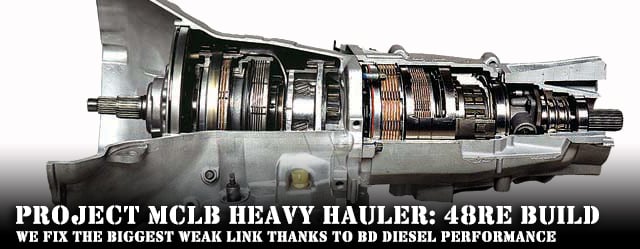
The concept behind Project MCLB Heavy Hauler is to build a reliable medium power truck that is capable of doing everything nosotros desire. First and foremost, we must be able to tow heavy loads. Second, we want to be able to enjoy the truck and not worry nearly whether we can make it back home or not. Tertiary, information technology must await adept, be comfortable and fun to drive. Last, we demand to take enough ability that nosotros tin can take some fun with it.
When edifice a truck, it is always a good idea to have an cease goal in mind. Then you can piece of work backwards to figure out how to get there. This way, you know what major purchases you need to make and when you lot need to upgrade your weak links. Our Projection MCLB Heavy Hauler is a 2006 Dodge Mega Cab powered by a five.9L Cummins with a 48RE transmission behind information technology. The 48RE is known for its share of problems, so for aid, we turned to BD Diesel fuel Performance.

A very mutual failure on the 47 and 48RE transmissions is the overdrive direct clutch snap band according to Jared Simmons of Diesel Dynamics
Weak Link
In our project truck, the weakest link is the manual. The question is when does it need to be addressed? The truck has 138,000 miles on it and every bit far as we know, it is bone stock. Typically, when someone starts to upgrade their late model truck, one of their first purchases would exist a tuner. In our situation, a decent tuner (bumping the horsepower up to most 500 horsepower to the rear wheels) would speedily atomic number 82 to a broken transmission.
The manufactory 48RE transmission is barely able to hold the stock horsepower and only near doubling the power would certainly end its life in a timely fashion. Since reliability is at the top of our listing, the transmission is the first thing nosotros are going to tackle.
To address the issue head on, we called the guys at BD Diesel Operation to talk over our options and figure out exactly what we needed. "Nigh factory transmissions neglect from burned upward clutches or broken difficult parts like a shaft or planetaries," said Cam Rose Technical CSR for BD Diesel Performance.
"A stock manual typically lives somewhere between 100,000 and 200,000 miles, but I have seen them fail with as little as xxx,000 miles; especially in the later trucks with more ability. So, nosotros pretty much recommend doing a 47 or 48RE transmission someday yous starting time increasing the horsepower," explained Rose.

Our Kickdown Ring was nonetheless belongings, only showing signs that it was well-nigh to fail.
(Left) Nosotros went ahead and ordered a complete valve body instead of modifying our original. (Right) The BD force per unit area controller is extremely easy to install. It simply has two plugs for the transmission (ane male, one female) and one plug for the knob. No power, basis or annihilation else needed.
Pump Upwardly The Pressure
With how expensive a complete manual can be, there are someways to strengthen it earlier a major upgrade is needed. "Nosotros accept a pressure controller that is a good idea at whatever level, fifty-fifty on a stock transmission. Particularly if a guy has a mild upgrade, the pressure controller is a groovy idea. It is a uncomplicated plug-in product that bumps upwards line pressure and helps the clutches and bands hold better. Increasing line pressure can really extend the life of the stock manual and it helps for performance transmissions every bit well. And then it is a good investment at any time. Same goes with the valve body. Considering the valve body volition firm up shifting and heighten line pressure it helps to preserve the manual. Given you tin supercede the valve body without removing the transmission; it'south very sensible and a adequately price-effective upgrade," Rose said.
There is only then much room inside a transmission. In social club to an actress clutches, the pressure level plates are machined down.
What To Upgrade; When?
Transmissions are one of those assemblies that consist of numerous complex parts. Many upgrade options be for every component and it tin can be hard to know what you lot actually demand to upgrade and what you don't. Often, there are fifty-fifty multiple options to choose from when upgrading a component. Like with BD Diesel Functioning'south kits, they offering ii different types of clutch material and many upgrades inside of the transmission.
Both materials are much improve than factory clutch material, pregnant they are more durable. The deviation comes into play when you are looking at building a full race truck. The BD Diesel Performance racing clutches have such a loftier friction coefficient, that the gears engage aggressively. Where every bit the non-racing clutch material engages a piffling easier. Both will concur and work well. The racing clutches are intended for the 1,000 horsepower rigs and trucks that alive on the track.
 When information technology comes to the rest of the internals, Rose says "The actual guts of our manual; the pump modifications, extra clutches, upgraded planetaries and and so along, are the same for all of our transmissions." According to Rose, once you upgrade, yous don't take to worry about whether yous are going to burn upwards a clutch.
At that place is a caveat to this, in one case the clutches engage and hold the power, another upshot tin arise. Depending on the ability level, of the truck shafts tin pause. One of the best things about a diesel engine is the huge amount of torque it produces. Torque, all the same, is a twisting strength and it has a way of breaking things.
The upgraded billet shafts have the same splines as a factory shaft. What makes them stronger is the material, the rut treatment and the profile of the shafts.
"I use the post-obit rule of thumb when it comes to upgrading shafts: 450 hp requires a billet input shaft, 550 hp barracks output shaft, 650 hp you ameliorate do all iii; input, output, intermediate. Anything at 700 hp and above you want to further upgrade to the larger billet input shaft. The larger input shaft is called a fatty input shaft and in that location is a special torque converter that goes with that, to have the larger shaft," continued Rose.
Converter
With a sound idea of exactly what nosotros need for a transmission, the only thing left to consider was the torque converter. Torque converters are a really interesting part. Their task is to sideslip 100 percent at idle and then transfer 100 percentage of the ability from the engine to the transmission when accelerating. All of this is washed while in that location are no physically connected parts between the transmission and the flywheel.
 A torque converter is basically a hydraulic pump. The outer shell and stator move at engine RPM. The stator'southward job is to take the fluid inside of the torque converter and straight information technology over to the front comprehend/pump. The front encompass then slings the fluid over to the turbine blades, which are mounted on the transmission'southward input shaft.
This action is what creates the power that drives the transmission and moves the vehicle. When in higher gears most torque converters can "lock up" bypassing this hydraulic side of the torque converter and directly connecting the outer crush to the transmission's input shaft via a set of lock up clutches.
Stall Speed
"Contrivance converters have a stall speed of approximately ii,100 rpms which is really too loose for the Cummins. This is why they tend to slip a lot off the line. We bring that down a few ways. We use a CNC billet stator and furnace braze all the fins [veins] on the converter. Brazing the fins has a few benefits. They won't chatter around and they concluding longer. In addition, it fills all the gaps around the veins so you get less fluid leaking through the veins. Of form lost fluid is lost ability and it creates more than estrus," explained Rose.
We bring the stall speed down to around 1800 and this makes the truck much more responsive – Cam Rose

"With these modifications, nosotros bring the stall speed downwards to around 1800 and this makes the truck much more responsive. We do have extra low stall speeds and high stall speed options but, these are really just for racing," continued Rose.
The other key aspect, is torque converter lock-upwards. The big 3 offer lock-up torque converters as standard equipment from the factory because of the meliorate fuel economic system. In the aftermarket, 99% of torque converters you lot will encounter will, too, be lock-upward. The simply real exception is a few racing converters.
BD Diesel Operation is i of the merely companies to offering two versions of the lock-up. There is a single disk lock-up and a triple disk lock-up. "The single disc is easily capable of handling 450 hp and honestly we've had run in with rigs much higher than that. Just really, one time you move beyond that, and start making serious power and torque, we recommend the triple disk," explained Rose.


What We Ordered
| Function # | Clarification |
| 1060618 | Build-Information technology Stage 4 Kit |
| 1030423 | Valve Trunk '05-'07 |
| 1600115 | Barracks Input Shaft |
| 1600117 | Billet Intermediate Shaft |
| 1041210 | Flexplate |
| 1071217X | Triple Torque Converter |
| 1030348 | Pressure Controller |
Options
Given our build plans, we demand everything. Triple disk converter, full billet shafts, upgraded internals, valve trunk, and pressure controller. There are really three ways to get this done. We could purchase a complete manual, we tin have a local transmission shop rebuild our transmission with an aftermarket rebuild kit, or we can buy the rebuild kit and do the work ourselves. There are pros and cons to each of these. Buying a complete transmission will cost the most, but it volition piece of work right, will have a good warranty, and the truck will only be down for a day or so, while someone pulls the old unit out and sticks the new one in.
If you decide to pay a local transmission shop to build the transmission, they tin apply many of the aforementioned parts and the downwards time may increment past a day or so. This option does let you pick what manufacture parts become in. The transmission should work merely fine and you lot will have a warranty as well. Generally, the local shop'southward warranty volition be a little less than a manufacturer'south warranty, but nevertheless a warranty. The cost on this could be slightly less than a complete unit.
The 3rd selection and one nosotros really promise our skilled DIY'ers consider is to build the manual yourself. The 47 and 48RE transmissions are actually very straight forrard. If yous have never built a transmission before, this is a skillful one to starting time with. This isn't 1 of those transmissions where yous have to worry virtually putting in an O-band backwards or anything odd. It is straight forward and something we feel most of our readers tin can practise. In that location is a huge savings in doing the transmission yourself. The reason is that a large portion of the price in rebuilding a manual comes from labor. So, by doing information technology yourself, you can relieve a good amount of money (Could be a way to possibly splurge for the billet shafts). The major downside is that you lot are the ane responsible for the warranty.

There may be a lot of parts in this picture, simply proceed in mind that they are broken up into smaller sub sets. Each clutch pack has its own set up of parts. Each clutch pack uses basically the aforementioned parts merely different sizes. Then, really, there are only almost 12 sets of parts and that is identifying the torque converter, flywheel, oil pan, and valve body as separate parts..
Our Pick
We opted to have our local operation shop (Diesel Dynamics in Joshua, TX) rebuild our manual with everything in BD'southward phase 4 transmission, including a billet input shaft and intermediate shaft, likewise as a triple disk converter. (We plan on upgrading the output shaft afterwards.) We chose this option for two reasons. The first reason was down time and the second reason was the warranty. Not but do they offer a warranty on all of their work, but they were more than happy to walk us through the process.
"For anyone wanting to do this themselves, I recommend buying the ATSG [Automatic Transmission Service Grouping] rebuild book," said Jared Simmons, Master Technician at Diesel Dynamics. "Really, if y'all tin can rebuild your transmission, you lot can save a ton of money and the 48RE'due south are easy," Simmons continued.
Removal And Tear Down

After getting our parts from BD Diesel Performance, we headed to Diesel fuel Dynamics. Simmons likes to drain the transmission fluid earlier he even starts to pull the transmission. This helps to reduce the mess and can give him a decent idea of the condition the transmission is in.

With the fluid draining, Simmons made quick work of removing the driveshaft, transmission cross member, libation lines, torque converter bolts and bell housing bolts to drop the transmission.
With the transmission on the bench, the torque converter was set off to the side and the extension housing of the transmission was pulled off.
Simmons then laid the transmission on its side and pulled the valve body off. Then he removed the pump.

The transmission had 138,000 miles on information technology. Fifty-fifty though the magnet has lots of metallic on it, it appears in that location isn't much habiliment. (Bad transmissions would have a ton of stuff on the magnet.) (Left) The valve trunk comes out as one unit of measurement. So, just some of the bolts get removed. If nosotros were installing a shift kit, the other bolts would be removed on the bench, but we accept a complete valve body then we won't demand to become into information technology. (Correct) The pump has a threaded concur, and then you tin screw in a bolt and work the pump out. It may feel pressed in, but it is just a expert fit and will come out with a little persuasion.
The first major associates to come out of the transmission is the direct drum. The direct or front clutches are located inside the drum and it is mounted against the Frontward drum. The forrad drum, yep y'all guessed it, has the forrad clutch assembly. In our transmission, everything looked ok.
(Superlative) Direct Drum. (Bottom Left) Directly Clutches, (Bottom Right) Forward Clutches. Our manual showed little sign of any potential effect, so far.
To cease the direct drive assembly, Simmons used a specialty took to depress the piston springs down, then he could remove the snap band. At home, this tin can be accomplished with two C-clamps.

While this tool is a specialty tool for disassembling a transmission, all it is actually doing it depressing a set of springs. A couple well place C-clamps could exercise the same chore.
The next major group of parts to exist removed were the shell, rear planetaries, reverse ring and reverse drum.
With the main internals removed, Simmons knocked out the intermediate shaft support, and removed the kickdown servo and contrary servo.

Once the final assemblies were removed, the transmission case was almost ready. Just the 2 servos and the intermediate shaft support had to be removed.
This pretty much emptied out the main instance. Simmons ready the case off to the side for cleaning and picked up the extension housing.
The first set of clutches to exist removed was the overdrive clutches. These showed some signs of overheating and wear.

But upon removing the overdrive clutches, Simmons pointed out a very common event. The snap ring that holds our overdrive straight clutches in identify was really broken. When Simmons took the overdrive assembly over to the press to remove, he noticed that a few of the pieces were pushing out. In fact, the snap ring was in 4 pieces. He believes nosotros only had a few thousand miles before failure.

(Tiptop) The entire overdrive associates comes out in one large section. (Bottom) The snap ring that holds in the overdrive direct clutches was cleaved in four pieces. If we had done a tuner first, this would accept failed even faster.
To compress the spring inside the overdrive hub, Simmons used a press. Once the pressure has been removed from the snap ring, it can be removed. Ours kind of fell out considering of how many pieces it was in. If you don't accept a printing at dwelling, you tin can accept this assembly to most shops and they can practice this for you. This is really the only specialty tool needed to rebuild this transmission.
Reassembly
Just like yous never assemble an engine without greasing upwardly the begetting, yous should never assemble a transmission without soaking the frictions!

(Top) Simmons just cut a foursquare out of a coolant container and filled information technology with ATF+iv fluid to soak the frictions. (Bottom Left) When assembling a transmission, make certain yous use transmission lube and not begetting grease. Simmons uses Dr. Tranny lubegard. The difference is that transmission lube will basically dissolve one time the tranny has been started. Bearing grease won't and it will prevent the transmission from working properly! (Bottom Right) Hither is what the straight drive piston looks like disassembled. These 9 springs are what need to be compressed to install the snap ring.
Simmons starts the reassembly by installing a new begetting into the direct drum and then installing the supplied piston plate.
Next, the direct clutches go in. Anytime you are installing a clutch assembly, i steel (metallic disks) goes in, then a friction, and then a steel, and so on until yous are finished. One matter Simmons recommends is to keep all of your old clutch assemblies together. This style, yous can tell which steels go where. Sometimes like in this 48RE, at that place is a very slight difference in thickness between the direct clutch steels and the forward steels. If y'all get them backwards, the tolerances won't be right.
The Forrad clutch pack is the adjacent to be assembled. This clutch pack has the same OD and ID every bit the direct clutch pack. So, information technology is easy to get the steels mixed up. Even a seasoned pro like Simmons had to really await twice at the steels to ensure they were right. Once assembled, the clutch packs should have the same tolerance.
With the case cleaned and painted, the components are re-assembled in the order they came out. So, the Intermediate shaft support, then the reverse pulsate, ring, rear planetaries, crush and forward planetaries were installed.
Adjacent, the directly drum and forward drum assembly with the new barracks input shaft goes in. This ended up being a two person task. One turned the intermediate shaft equally the other turned the input shaft and wiggled the drum assemblies to get the friction teeth to line upwardly with the direct hub.
With the pulsate assemblies in place, the kickdown ring was installed and the pump body went on to end the front instance associates.

Simmons turned his attending to the valve body next. He pulled the electronics off the old body and installed them on the new BD Diesel Performance valve body. Later on installing the servos, he installed the valve body.

Another key role that nosotros opted to upgrade was to a larger aluminum transmission oil pan. These are great for reducing the transmission temperatures. Not only practise they hold more fluid, only they are made out of thick aluminum, which helps to remove more heat from the fluid.
Simmons then completed the overdrive straight clutch assembly and took the entire assembly over to the press to install a new snap ring.

With the snap ring in identify, the unabridged assembly was slid dorsum into the extension housing and the overdrive clutches were installed.
Then the two sections were reconnected to make one complete manual.
The last component on the transmission was the new triple disk torque converter. When you are installing one of these, make sure you hear/feel it fully seat. Turning and gently wiggling it volition usually marshal it to the "2d" seat. It volition click into place equally it moves back. Then information technology is truly in.

Anytime a torque converter is installed, be sure to fill it with transmission fluid.
One issue that Simmons says he regularly sees on the Cummins engines are broken manufactory flywheels. He says that your money is well spent to purchase a practiced aftermarket one that won't suspension. We went with BD Diesel's SFI billet flywheel.
Once the flywheel was installed, it was just a thing of bolting the transmission dorsum in identify and tightening everything. As you tighten the transmission bellhousing bolts, make sure the torque converter is able to spin freely and not bound. If information technology stops spinning, this is well-nigh likely caused from non getting the torque converter fully seated. Tightening the bolts more will not seat the torque converter, just may cleft the bell housing.

The last task was to install the pressure controller. It was only a matter of connecting to the two wires connectors in line with the transmission throttle valve actuator (TTVA) motor. We mounted the module under the hood and ran the control switch to the dash.
Final Thoughts
While this isn't a manufactory rebuild kit, everything does fit together like a factory kit and all of the tolerances were well within spec the first time. It should probably be noted that BD's tolerances are actually tighter than Contrivance's specs are. Nosotros should also mention that some of the wave snap rings are replaced with flat snap rings. Between ramping up the manual pressures and removing some of the cushioning, this transmission does shift a lilliputian firmer than a manufactory manual simply daily driving this truck is pretty much the aforementioned equally with a factory transmission. Once we turn the dial on the pressure controller over to race, the shifts are much more firm. When we are at the rails, everything just feels right and the shifts are exactly what we want.
Stay tuned and keep checking back as we have this Project to the next level!
Source: https://www.dieselarmy.com/engine-tech/drivetrain/project-sacrifice-48re-trans-build-bd-diesel-performance/
0 Response to "Is There a Way to Beef Up the Overdrive on a 48re"
Post a Comment