Fritz Scholder Indian Chief Art Signed Fritz Scholder Indian Chief Scottsdale Az Art Signed
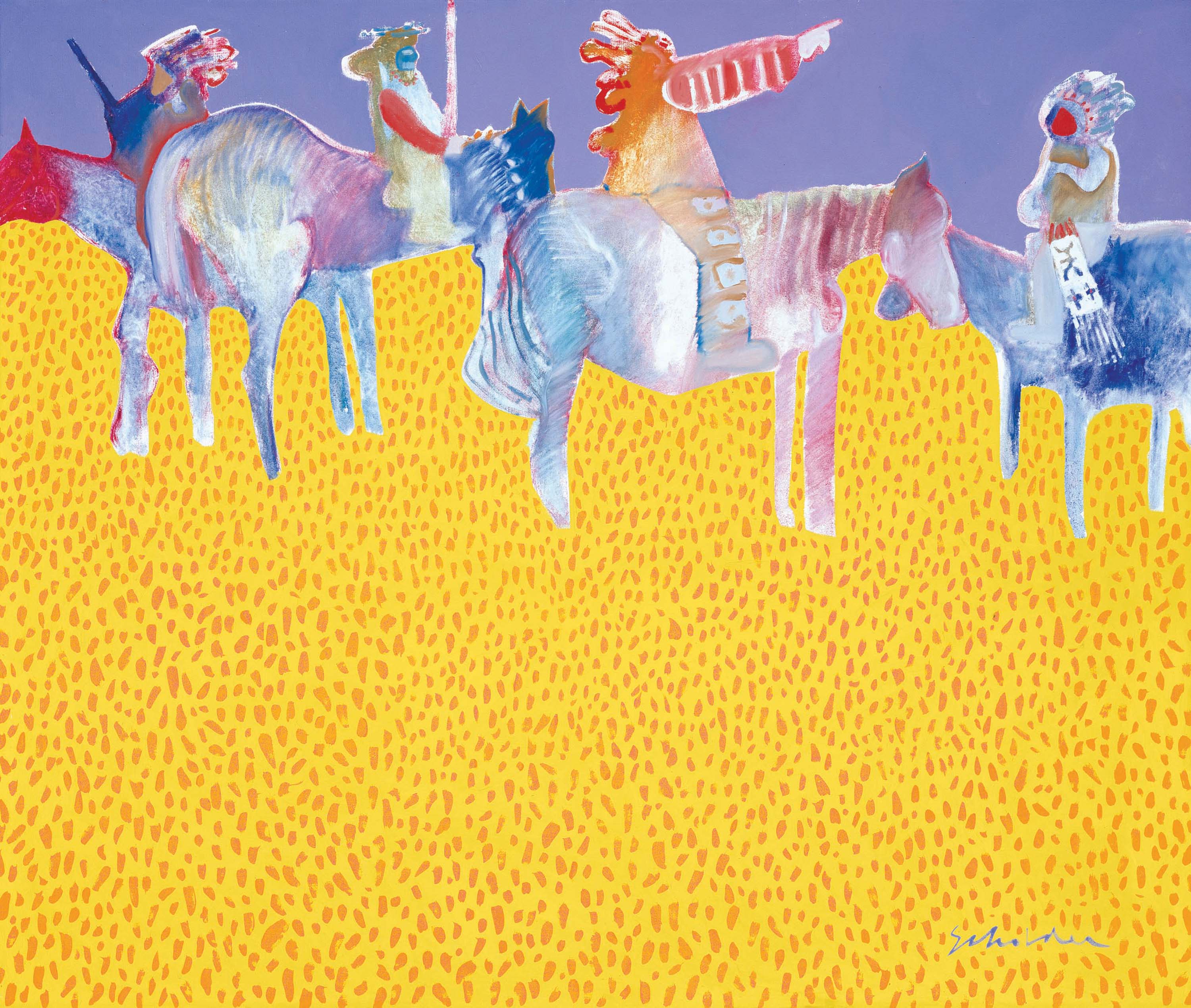
"Four Indian Riders" | Oil on Canvas | 1967 | 60 x 72 inches | Collection of Mr. and Mrs. William Metcalf | Photograph past Walter Larrimore, NMAI
04 Aug Perspective: Fritz Scholder [1937-2005]
In 1969, Fritz Scholder completed the small canvas Indian with Beer Can — and Native American art was never the same. In fact, dorsum then there was no such matter equally Native American fine art. Archetype Navajo chief's blankets and Mimbres pictorial pots were relegated to dusty displays in anthropology museums. Even Maria Martinez'due south wonderful blackness-on-black ceramics were condescendingly written off as high-end crafts. Indian with Beer Can inverse everything.
Today, the question lingers in the air like an unfinished argument: How did an artist, who often denied his Indian background, blossom into a painter who came to define that very category of art? All Scholder ever wanted was to be appreciated as an artist, rather than an Indian artist. Perversely, he discovered he could only brand a living if he was perceived as a Native American who painted Indian imagery. It would remain a lifelong source of frustration.
Fritz Scholder was born in 1937 in Breckenridge, Minnesota. His male parent was an administrator in the local Indian school and was employed by the Bureau of Indian Diplomacy. As Scholder recalled, his parents acted as if they were aback of their heritage. When his female parent and male parent were married, they received nuptials gifts that included Navajo rugs and woven baskets. Still, they refused to display them in their dwelling house, preferring not to think of themselves as Indians. It wouldn't take much of an imagination to recognize how this was the source of Scholder's unresolved issues over his background.
Fortunately, his family valued pedagogy, with Scholder attending both the Academy of Kansas and Wisconsin Land College. Past 1957, he had moved to Sacramento, where his art studies kicked into high gear under the tutelage of Wayne Thiebaud at Sacramento Urban center College. A twelvemonth later, he was given his first one-person show by the schoolhouse, and never looked back.
The real enigma was how such a conflicted personality fabricated such great art. While Scholder's 1998 retrospective at the National Museum of the American Indian, aptly titled Indian/Non Indian, gave the public a provocative overview of his piece of work (and a valuable catalog), it did petty to answer the question. If you lot agree with Francis Bacon, who said an artist's task is to "deepen the mystery," then Fritz Scholder would qualify as a bona fide CEO of a Fortune 500 company.
What's interesting is that Bacon was arguably Scholder'due south greatest influence. Early in his career, he traveled to London to see the painter'south work at the Tate Gallery. Scholder walked away mesmerized. Simply in a pattern that would help shape his career, Scholder "lifted" Bacon's distinctive format. Dating back to his teaching years at the Institute of American Indian Arts (1964 – 1969), Scholder was accused on more than i occasion of stealing ideas from his students. Defenders of the creative person say while that may very well accept been truthful, his students didn't have their teacher's talent, drive or connections to succeed with the concepts he appropriated. It's worth thinking about. After all, no less an authority than Picasso is believed to have one time said something to the effect of: "Good artists infringe, great artists steal."
Scholder was able to parlay what he learned from Bacon and Thiebaud into a language that took static images of Indians and transformed them into figures loaded with feeling and emotion. Polly Larsen, co-owner of Larsen Gallery in Scottsdale, Arizona, America'south largest dealer of Scholder paintings on the secondary marketplace, explained, "Scholder wanted to pigment the Indian 'existent,' instead of the romanticized versions past George Catlin and Karl Bodmer." He managed to do so by placing his Native American subjects in ironic scenarios. He portrayed them as stereotypical Indians, in dress and ritual, who ate ice cream cones and draped themselves in the American flag. They even wore Western shirts, Stetson hats and hung out at cowboy bars — merely like the figure depicted in Indian with Beer Tin can.
In a manner, this painting is a Rosetta Stone that can be used to partially demystify Scholder. It's worth pointing out that the moving-picture show was purchased past Ralph Lauren. If there's a unmarried name in American civilization that'due south synonymous with the adept life, it'due south Ralph Lauren. Built-in Ralph Lifshitz to Jewish immigrant parents from Belarus, Lauren observed that most Americans came from mixed lineages, merely often aspired to the so-called WASP lifestyle. Capitalizing on that realization, Ralph Lauren created a fashion empire, much in the way that Scholder reinvented himself in an endeavour to live the adept life divers by Lauren.
In that location's a famous black-and-white photograph of Scholder — posed formally in front of his Rolls Royce convertible, holding the leash to a magnificent Afghan hound and with a towering saguaro in the groundwork — that was a metaphor for the creative person'south awe-inspiring success. It was as if Scholder needed to remind himself how far he had come in the world.
Setting the stage for his meteoric success, in 1974 Scholder joined Scottsdale'southward Elaine Horwitch Gallery. It was the fortuitous meeting of ii forces of nature. Horwitch, who was a character in her own right (she collected and rode motorcycles), sensed something in the air when she invited Scholder to join her gallery. In a period that spanned the tardily 1970s through the early 1980s, wealthy Americans began to fall in love with the Southwest, partly through the efforts of Lauren and W magazine, who helped define the so-called "Santa Iron Mode." They bought second homes in Scottsdale, Santa Fe and Jackson Hole. They busy their holiday residences with Molesworth article of furniture and paintings with Western themes. Past acquiring a Scholder, collectors could take it both ways: They could prove they were politically correct — this was the tail-end of the radical AIM (American Indian Motion) — while decorating their homes with iconography that defined the region. Even amend, they latched on to what appeared to be a expert investment.
According to Julie Sasse, who once worked for Elaine Horwitch and is currently the Main Curator and Curator of Mod and Contemporary Art at the Tucson Museum of Fine art, "Fritz Scholder was definitely a superhero in Scottsdale — when he showed up in his Rolls on Marshall Fashion anybody stood up and took notice. Scholder caught on considering he was not making saccharine images. He had an original palette, and he possessed a unique vision. It was as if Francis Bacon met Abstract Expressionism."
Just that era cruelly ended when the fad for Southwestern art faded in the mid-1980s. The Scottsdale scene contracted and Scholder left the Horwitch gallery. Sasse recalled, "He left Elaine because she could no longer meet his escalating demands. He kept raising his prices and insisted on a monthly guarantee, while also expecting a catalog and posters for each show. But what he really wanted was to go off and pigment whatever he felt like painting." Scholder visited Egypt and began a serial of pictures depicting sarcophagi, augmented with bronze casts of obelisks. They never actually caught on. Sasse added, "He idea his audience would follow him."
To his credit, Scholder continued to redefine his art on his own terms. He began to look more closely at Nathan Oliveira, the esteemed Bay Area figurative creative person. He incorporated Oliveira's looser brushwork, mimicked his elongated figures, and captivated his slightly acidic color. Information technology was equally if Scholder had been emancipated. His imagery drifted away from Indians and began to wait more like gimmicky art destined for SoHo. Scholder'southward piece of work now explored the more existential issues of painting. He became concerned with painting as an extension of the man spirit.
During the mid-1990s, Scholder embarked on a series of portraits — with titles like Heaven, Hell and Purgatory — that reflected his preoccupation with a life that was winding down. In that location's a telling self-portrait of the artist in his old age, seated in his studio, wearing sunglasses and tethered to an oxygen tank, chosen Self-Portrait with Grey Cat. Painted ii years before his expiry in 2005, he seemed to be request himself, "Is this what my life's come to?"
However Scholder had much to be proud of. After all, how many artists come to define an entire genre of art? His legacy is assured; a scan of the creative person's biography reveals the inclusion of his work in more than than 100 public collections. Equally of import, Scholder gave time to come Native American painters permission to annotate on what it's similar to be an indigenous person trying to retain his traditional roots in a modernistic world.
The Cochiti artist Diego Romero, whose work is equally chock full of irony, had this to say nearly Scholder: "We all have to acknowledge his identify every bit an artist who paved the manner. Just every bit Maria Martinez was the matriarch of Indian ceramic artists, Fritz Scholder was the patriarch of Indian painters."
At the end of the solar day, an artist is judged on his aesthetic high-h2o marker. Fritz Scholder left a considerable footprint on art history, filled with a stream of exhibitions, accolades and honors.
On a personal level, he had a remarkable lifestyle. His world was the proverbial movable feast with homes (at various times) in New York, Taos and Santa Atomic number 26. Scholder besides assembled a substantial art collection that included several portraits of himself that he commissioned from Andy Warhol. Whether he won his lifelong struggle to be seen as a pure creative person is debatable. Only 1 thing is certain, if the title of Calvin Tomkins' Living Well is the All-time Revenge is to exist believed, then Fritz Scholder got his revenge in spades.
Source: https://westernartandarchitecture.com/articles/perspective-fritz-scholder-1937-2005
0 Response to "Fritz Scholder Indian Chief Art Signed Fritz Scholder Indian Chief Scottsdale Az Art Signed"
Post a Comment